
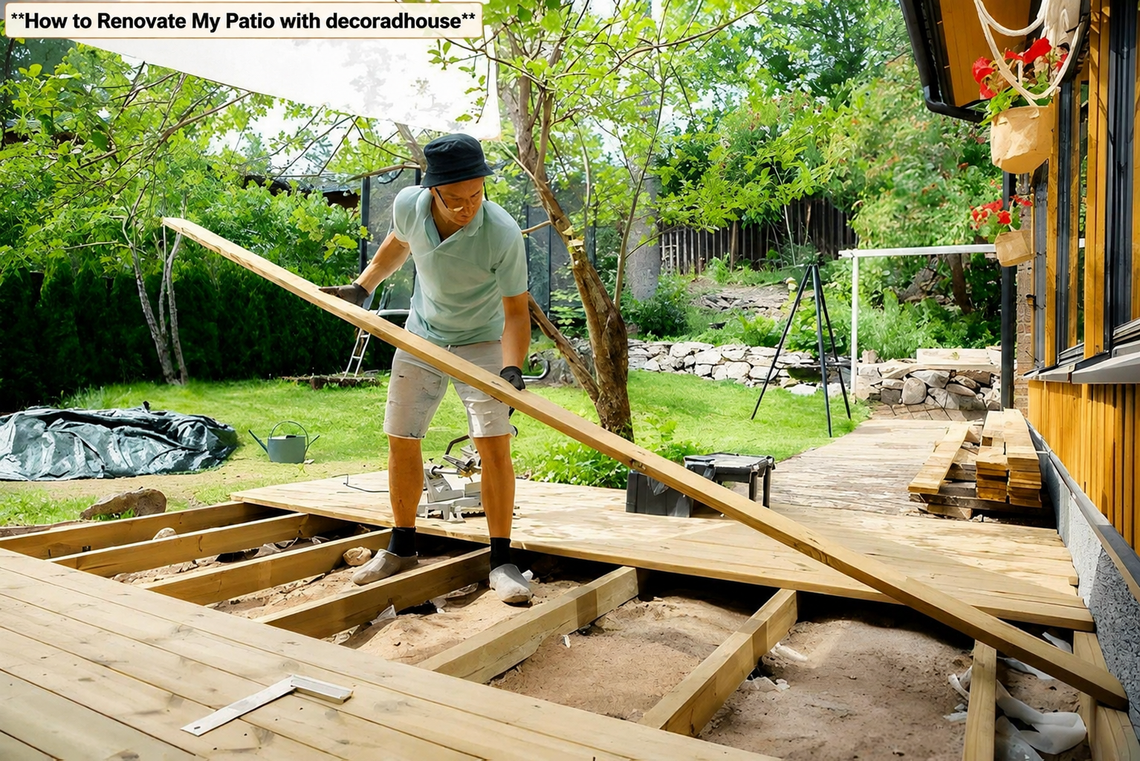
Most Canadian patios spend eight months under snow or rain and two months looking like they survived it. Cracked concrete, peeling paint, wobbly chairs that should have gone to the curb in 2019 — it adds up fast. The good news? You don’t need a contractor, a permit, or a second mortgage to fix it.
This guide walks through exactly how to renovate my patio decoradhouse style on $500 or less. You’ll find out where to put your first $50, what to skip entirely, and how to get a finished outdoor space that actually holds up through a Canadian spring. Whether your patio is 100 square feet of tired concrete or a dated wooden deck with loose boards, the same priorities apply: fix structure, add surface, layer in comfort.
Here’s what this article covers: a budget breakdown, the right order of work, material choices for cold climates, and a cost-per-upgrade table so you can pick and choose what fits your budget.
How to renovate my patio Decoradhouse : Start With What’s Broken
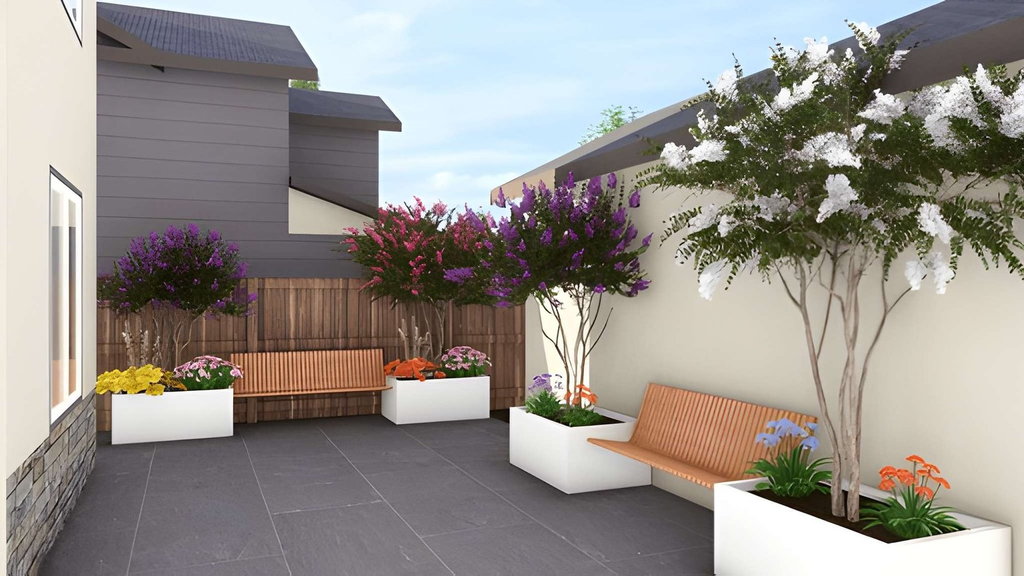
Before you buy anything, spend 20 minutes assessing your actual patio. Run your hand along the surface. Push on the edges of any pavers or boards. Check where water pools after rain — that’s where your problem is.
Most patios under $500 need one of three fixes:
- Concrete patios — cracks, surface staining, or drainage issues
- Wood decks — loose boards, rotted sections, faded finish
- Paver patios — sunken sections, missing joint sand, weed overgrowth
Fix structure before aesthetics, always. A fresh coat of deck stain on rotted wood looks good for about six weeks. Replacing two rotted boards now prevents replacing twelve next spring.
Quick assessment checklist:
| Problem | Fix | Approx. Cost (CAD) |
| Cracked concrete (hairline) | Concrete crack filler + sealant | $25–$45 |
| Sunken paver | Re-level with polymeric sand | $30–$60 |
| Rotted deck board (1–2 boards) | Replace boards + stain | $60–$120 |
| Faded/peeling deck paint | Strip + reseal | $40–$80 |
| Standing water | Gravel drainage trench | $50–$90 |
The $500 Patio Budget: Where the Money Actually Goes
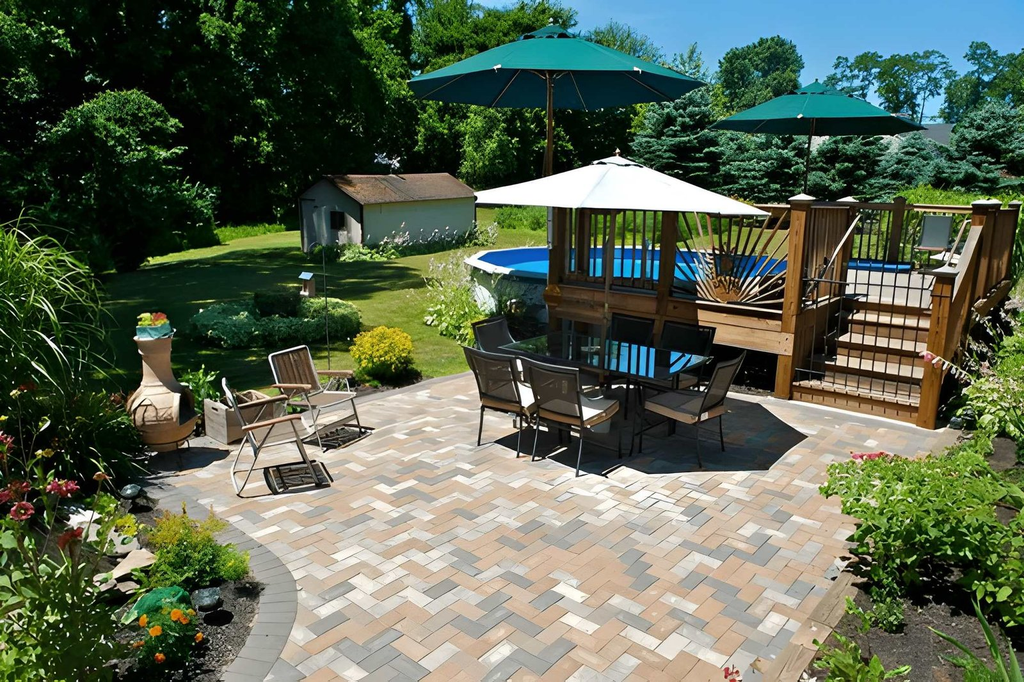
A $500 budget sounds tight until you break it into categories. Most homeowners overspend on furniture and underspend on surface prep. Here’s the split that works:
| Category | Budget Allocation | Why |
| Surface repair & prep | $80–$120 | Foundation of everything else |
| Outdoor rug or pavers | $60–$100 | Biggest visual change per dollar |
| Furniture (secondhand or flat-pack) | $100–$180 | Kijiji and Facebook Marketplace do most of the work here |
| Lighting (solar or plug-in) | $40–$70 | Changes how the space feels at night |
| Plants & containers | $30–$60 | Adds life without requiring landscaping |
| Paint or stain | $30–$50 | Fence, furniture, or accent wall |
| Cushions / textiles | $30–$60 | Comfort that doesn’t cost much |
| Total | $370–$640 | Stay under $500 by buying secondhand furniture |
The fastest way to blow past $500 is buying new furniture at retail. A matching bistro set from a big-box store runs $200–$400 alone. The same set shows up on Kijiji every spring for $40–$80 because someone moved or upgraded.
Material Choices That Survive Canadian Weather
This is where Canadian patio renovation differs from the US guides most homeowners find online. Materials rated for USDA Zone 6 don’t automatically work in Ontario Zone 5b or Alberta Zone 3. Cold-climate priorities:
Outdoor rugs — Choose polypropylene, not cotton or jute. Polypropylene handles freeze-thaw cycles and dries fast after rain. Avoid anything with a woven backing that holds moisture.
Furniture — Powder-coated steel, aluminum, and teak hold up. Resin wicker is fine for covered patios but cracks after a few years exposed to UV and cold. Avoid untreated wood unless you plan to seal it every season.
Concrete sealant — Use a penetrating silicone or polyurethane sealant, not a surface acrylic. Acrylic peels in freeze-thaw conditions. Penetrating sealants work from inside the slab.
Deck stain vs. paint — Stain every time for wood decks. Paint traps moisture, stain lets the wood breathe. Semi-transparent stain on cleaned cedar lasts 3–4 years with zero maintenance between coats.
Pavers — If you’re adding any, choose concrete or natural stone rated for Zone 3 or colder. Porcelain pavers are beautiful and available at a lower cost now, but require a properly compacted base or they shift in frost.
How to Renovate My Patio in the Right Order
Getting the sequence wrong wastes money. Stain your deck, then discover a board needs replacing, and you’re redoing that section. Here’s the order that works:
Step 1 — Repair structure. Replace damaged boards, fill cracks, level sunken pavers. Do this before anything else touches the patio.
Step 2 — Clean the surface. Pressure wash concrete and decking. Use a deck cleaner on wood, an alkaline cleaner on concrete stains. Let it dry completely — two days minimum before applying any finish.
Step 3 — Apply finish. Sealant on concrete, stain on wood, polymeric sand on pavers. This locks in your repair work and sets the surface for everything on top.
Step 4 — Lay the rug. If you’re using an outdoor rug, put it down before furniture so you can position it right. On concrete, add non-slip rug tape or a rubber mat underneath.
Step 5 — Bring in furniture. Arrange it before anchoring anything. Take photos of two or three configurations before committing.
Step 6 — Add lighting. Solar string lights along a fence or pergola, a solar lantern on a side table, or plug-in rope lights under a railing. Lighting makes a patio feel finished faster than almost anything else.
Step 7 — Add plants last. Pots and containers go in after furniture so you’re not shuffling them around to seat people.
Fast Upgrades Under $50 Each
If $500 feels like too much at once, these single upgrades move the needle immediately:
| Upgrade | Cost (CAD) | Impact |
| Outdoor rug (6×9 polypropylene) | $35–$65 | Defines the space visually |
| Solar string lights (20–30 bulbs) | $20–$40 | Evening atmosphere |
| Two planters + seasonal flowers | $25–$45 | Colour without landscaping |
| Concrete crack filler + sealant | $25–$45 | Stops damage from spreading |
| Outdoor cushions (4-pack) | $30–$55 | Immediate comfort upgrade |
| Privacy trellis (cedar) | $35–$60 | Blocks neighbours, adds structure |
For budget breakdowns by room and project, the full resource library at https://decoratoradvice.ca/ covers everything from small balcony setups to full backyard overhauls.
FAQ: Patio Renovation on a Budget
How much does it cost to renovate a small patio in Canada? A basic renovation covering surface repair, an outdoor rug, used furniture, and lighting typically runs $300–$500 CAD. Costs go higher if structural repairs are needed or if you buy furniture new.
Can I renovate my patio without removing old concrete? Yes. Concrete overlays, outdoor tiles, and pavers can all go directly over existing concrete if the slab is structurally sound and level. Fill cracks and seal first.
What’s the longest-lasting outdoor furniture for Canadian winters? Aluminum and teak hold up best over multiple seasons. Store cushions indoors between October and April regardless of what the furniture is made of.
Do I need a permit to renovate my patio in Canada? Surface-level work — refinishing, furniture, rugs, lighting — never requires a permit. Structural additions like a pergola or new deck platform may require one depending on your municipality.
How long does a patio renovation take on a $500 budget? Most of the work takes one weekend. Surface prep and drying adds one to two days. Budget two weekends total to do it without rushing.
The Bottom Line
Knowing how to renovate my patio decoradhouse style comes down to three things: fix what’s broken first, choose materials rated for the Canadian climate, and spend the most money on the things you’ll touch every day. A good outdoor rug and furniture you actually want to sit in will do more for a patio than expensive planters or string lights that look great in photos.
Start with the repair table above, pick your two or three highest-impact upgrades, and work through the sequence. Most homeowners who approach it this way finish under $400 and have budget left over for the next season.


