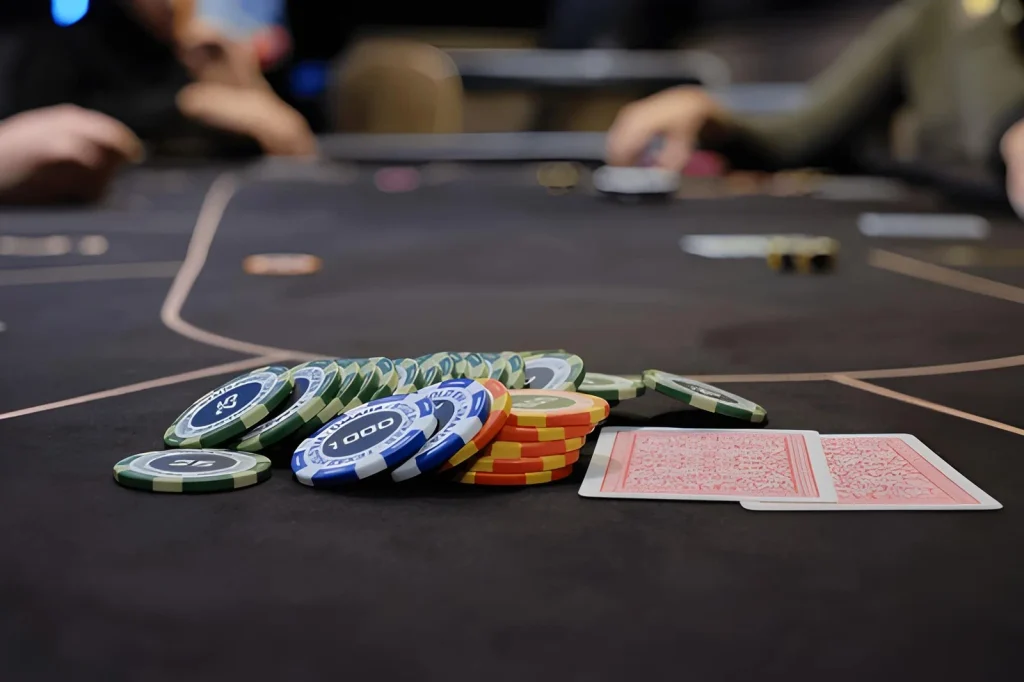
Most home poker rooms are designed around aesthetics first and player comfort last. That sequencing costs hosts real quality at the table. Sightlines and lighting geometry – not decor – determine whether eight players stay sharp through hour six.
The fix is less expensive than most people assume. It starts before you buy a single chair.
The Sightline Problem Nobody Talks About
Any player seated with their back to a doorway experiences a low-grade threat response. It is subtle but real. The brain allocates attention to monitoring that blind spot – attention pulled away from reading opponents and managing stack decisions in your poker game.
The fix: orient your table so the host seat and the highest-variance positions – typically the button and the blinds – face the room entry. Those spots rotate every orbit, so everyone cycles through the exposed position briefly rather than one person sitting there all night.
Windows create a second problem. Natural light is fine until hour three, when low afternoon or evening sun hits players at eye level. Seat players perpendicular to windows, never facing them.
Blackout blinds behind a sheer layer let you block hard light without making the room feel like a bunker.
Lighting Geometry: The Layer That Actually Matters
The most common mistake in home game rooms is a centered overhead fixture that throws shadows across half the table. A pendant hung too high washes the felt in flat light and creates a bright halo. Players’ eyes constantly readjust when they look up to read faces.
The target: hang the pendant so the light cone covers the full table without spilling into seated players’ eyes. A reliable rule is to position the bottom of the fixture roughly 30 to 34 inches above the felt.
For bulbs, use dimmable warm-white in the 2700K to 3000K range. Cooler, bluer light around 5000K increases alertness early but accelerates eye fatigue across a long session.
Add a second layer. Wall sconces or recessed perimeter lighting at mid-wall height fill the room without competing with the table fixture. This two-layer approach eliminates the high-contrast problem entirely.
Surface Choices That Reduce Ocular Load
Glossy surfaces – lacquered walls, polished wood floors, glass-topped side tables – create secondary glare sources that accumulate over a session. Matte or satin finishes absorb light rather than bouncing it.
Felt on the table rail and a low-pile rug under the table both cut reflective noise at the eye level that matters most.
Spatial Geometry: Fitting the Table to the Room
A standard oval poker table for eight players needs roughly 5 feet of clearance on all sides for comfortable chair movement and dealer access. That puts the minimum practical footprint at around 18 by 18 feet for a dedicated setup.
Larger spaces open up more options. A 22-by-44-foot game room can accommodate a poker setup alongside a pool table, air hockey, and a shuffleboard table without any area feeling cramped.
For tighter spaces, a poker table on a hardwood base that doubles as a dining surface works well. The priority is protecting that clearance zone – players should never be bumping elbows with the wall on a check-raise.
Seating: Where Comfort Meets Decision Quality
Chair height relative to table height is a detail most hosts get wrong. Those seated too low hunch forward. After two hours that posture tightens the shoulders and reduces peripheral vision.
Aim for:
- Seat height of 17 to 19 inches
- Table rail at 29 to 30 inches
- Forearms parallel to the table surface when seated
Padded armrests matter more than cushion depth. A player who can rest their arms comfortably stays physically neutral longer, which correlates with better emotional regulation at the table.
The Online Parallel: When the Room Isn’t an Option
Not every session fits a dedicated room. The same principles apply at a screen: reduce ambient glare behind the monitor and avoid sitting facing a window.
Platforms like GGPoker let you replicate the social structure of a home game online. Its private table builder supports customizable blinds, buy-ins, and formats with no extra fees.
GGPoker also offers real money poker across one of the largest global player pools, so if your regular group needs extra seats filled, outside players are easy to add.
The Ocean Rewards program tracks activity and returns value progressively – a good fit for casual home-game players who play in bursts rather than grinding daily.
Where This Is Heading
Serious home-game hosts are starting to treat their poker rooms the way recording studios treat acoustic design: the environment is part of the output.
Get the sightlines right first. Everything else is furniture. For anyone moving from a home texas holdem setup to online play, the transition is smoother than most expect.Read more at https://decoratoradvice.ca/.