Throw pillows are the most purchased, most debated, and most misunderstood decorating element in the American home. Everyone has an opinion. Some households pile them twelve deep on every sofa surface. Others have been told by a partner that one more throw pillow enters the house and something else has to leave. Interior designers post strongly worded opinions about exact numbers and arrangements. And underneath all of it is a genuinely useful question that rarely gets a genuinely useful answer.
How many throw pillows is actually too many?
The answer isn’t a fixed number. It’s a relationship — between the size of the sofa, the purpose of the room, how the household actually uses the space, and what the pillows are supposed to do visually and functionally. Get those variables right and the number follows naturally. Ignore them and you end up either with a sofa nobody wants to sit on because removing the pillows feels like dismantling an installation, or with a sofa that looks bare and unfinished because two sad cushions can’t do the visual work required.
This article gives you the honest framework for throw pillow decisions — numbers, sizing, arrangement, and when the conventional rules actually hold versus when they don’t.
Why Throw Pillow Advice Is Usually Wrong
Most throw pillow guidance fails for the same reason most decoration advice fails: it’s prescriptive without being contextual. “Three to five pillows on a sofa” is advice that works for some sofas in some rooms and produces bad results in others — but it circulates as a universal rule because it’s simple enough to repeat.
| Advice Type | Why It Fails | What Works Instead |
|---|---|---|
| Fixed number rules (“always use 5”) | Ignores sofa size and room scale | Number proportional to sofa length |
| “Odd numbers always look better” | True sometimes, false in symmetric arrangements | Odd for casual, even for formal — depends on intent |
| “Bigger is always better for pillows” | Wrong scale destroys proportion | Match pillow size to sofa depth and seat height |
| “Match your throw pillows to your sofa” | Produces flat, one-dimensional look | Contrast or complement — never identical match |
| “More is more for cozy” | Past a threshold, more is just inconvenient | Comfort and visual richness have different optima |
| “Remove them all for minimalism” | Bare sofa looks unfinished in most rooms | Scale-appropriate minimum still applies |
The Actual Formula: How Many Throw Pillows Per Sofa
The number of throw pillows a sofa needs is primarily a function of the sofa’s length. A two-seater loveseat and a four-seater sectional don’t need the same number — and treating them the same produces either overcrowding or sparse underperformance.
| Sofa Type | Length | Recommended Throw Pillows | Arrangement Logic |
|---|---|---|---|
| Loveseat | 52–64″ | 2–3 | One each end, one center or two symmetrical |
| Standard sofa | 72–84″ | 3–5 | Two each end, one center or asymmetric grouping |
| Large sofa | 84–96″ | 4–6 | Two each end, one to two center fill |
| Sectional (L-shape) | 100″+ | 5–9 | Anchor each end, fill corners, vary sizes |
| Daybed or chaise | Variable | 2–4 | Stacked against back, one or two forward |
| Bench or accent seat | Under 50″ | 1–2 | Centered or asymmetric pair |
These are ranges, not mandates. The lower end of each range produces a cleaner, more edited look. The upper end produces more visual richness and warmth. Neither is wrong — they serve different aesthetic intentions and different household personalities.
When Throw Pillows Become Too Many
There are two reliable signals that throw pillows have crossed from “intentional” to “too many”:
Signal 1: Nobody wants to sit on the sofa without removing them first.
If every household member moves throw pillows before sitting down and immediately puts them somewhere else rather than back where they were, the arrangement has stopped serving the people in the room. Decoration that requires management to use the furniture it’s on has failed at the functional level regardless of how good it looks.
Signal 2: The visual result is density rather than composition.
Too many throw pillows on a sofa don’t create more visual interest — they create visual noise. Each individual pillow stops being visible as a distinct element and the sofa reads as a pile of fabric rather than a composed arrangement. The point of a throw pillow arrangement is that each pillow contributes to the whole; when there are too many to distinguish, the whole stops working.
Throw Pillow Sizing: The Variable That Matters More Than Number
Most throw pillow arrangements fail not because of how many pillows are used but because the sizes are wrong for the sofa. Pillow size relative to sofa depth and seat height determines whether the arrangement looks proportional or awkward.
| Pillow Size | Best Sofa Type | Avoid |
|---|---|---|
| 12×12″ | Accent chairs, small loveseats | Full-size sofas — too small, disappear |
| 16×16″ | Loveseats, shallow-seat sofas | Deep-seat sofas — insufficient visual weight |
| 18×18″ | Standard sofas, most versatile | Rarely wrong — works across most applications |
| 20×20″ | Standard to large sofas, preferred size | Small loveseats — overwhelm the seat |
| 22×22″ | Large sofas, sectionals | Loveseats and standard sofas — too dominant |
| Lumbar (12×20″ or 14×22″) | Any sofa as accent — adds variation | Using as primary pillow without square backup |
The 18×18 and 20×20 inch sizes are the workhorses — they’re large enough to read clearly from across a room, small enough to work on most sofas, and the size most commonly underused by US homeowners who default to smaller pillows from mass-market retailers.
Arrangement Logic That Actually Works
Number and size established, arrangement is the final variable. The most common throw pillow arrangement mistakes aren’t about having too many or too few — they’re about symmetry when asymmetry would work better, or uniformity when variation would create visual interest.
The symmetric arrangement — same pillows, same sizes, mirrored on each end — works best in formal rooms and on sofas with clear bilateral symmetry. It reads as orderly and intentional but can feel static.
The asymmetric arrangement — different sizes, different textures, deliberately unbalanced — works best in casual rooms and creates visual movement that symmetric arrangements don’t. It’s harder to execute well but reads as more designed when it works.
The layered arrangement — large pillows at back, smaller in front, lumbar accent in center — works on deeper sofas and creates the hotel-bed quality that many homeowners are trying to achieve. It requires sufficient sofa depth (usually 36 inches or more) to layer without crowding the seat space.
| Arrangement Style | Room Formality | Visual Quality | Difficulty |
|---|---|---|---|
| Symmetric, same size | Formal | Orderly, static | Low |
| Symmetric, varied texture | Formal-casual | Refined, layered | Low-Medium |
| Asymmetric, varied size | Casual | Dynamic, interesting | Medium |
| Layered (large/small/lumbar) | Any | Luxurious, hotel-like | Medium |
| Clustered at one end | Casual, intentional | Relaxed, modern | Low |
| Single statement pillow | Minimal | Bold, edited | Very Low |
Frequently Asked Questions
What is the right number of throw pillows for a standard sofa?
For a standard 72 to 84-inch sofa, three to five throw pillows is the practical range. Three produces a clean, edited look. Five produces more visual richness and warmth. The deciding factor is the room’s formality level, the sofa’s depth, and whether the household regularly uses the sofa or primarily looks at it from across the room.
Is it true that odd numbers of throw pillows always look better?
Odd numbers work better in asymmetric, casual arrangements where visual movement is the goal. Even numbers work better in symmetric, formal arrangements where balance is the intention. The rule that odd numbers are universally superior is a simplification that ignores context — specifically, that symmetry and formality have their own valid logic.
What size throw pillows should I use on a standard sofa?
18×20 inch is the most versatile size for standard US sofas. It’s large enough to read clearly, proportional to most seat depths, and works in both symmetric and asymmetric arrangements. Going smaller — the 16×16 inch pillows common in mass-market retail — consistently produces arrangements that look underwhelming because the pillows disappear relative to the sofa scale.
How do I make throw pillows look intentional rather than random?
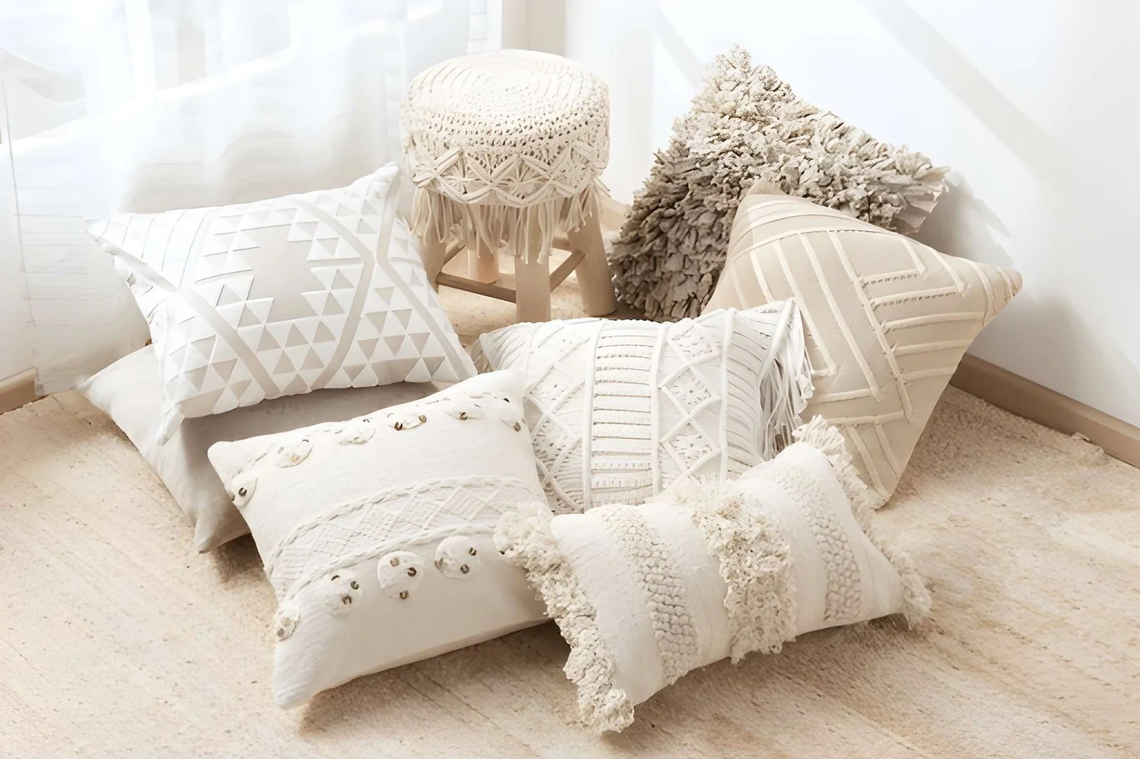
Limit the palette to two or three colors, vary the texture within that palette, and use no more than two or three pattern types in one arrangement. A solid, a subtle pattern, and a textured plain work together without competing. More than three patterns in one throw pillow arrangement almost always produces visual noise rather than visual interest.
Should throw pillows match the sofa or contrast with it?
Contrast or complement — not match. Throw pillows in an identical fabric to the sofa become invisible against it, which defeats the purpose of having them. A contrasting color or texture creates the visual separation that makes each pillow register as a distinct design element. The sofa and throw pillows should clearly belong together without being the same thing.
The Bottom Line
Too many throw pillows is a real thing — it happens when the arrangement requires management before the sofa can be used, or when the density of pillows produces visual noise rather than visual composition. But too few is equally real and equally common, particularly on larger sofas where a sparse arrangement looks inadvertent rather than edited.
The right number is proportional to the sofa’s length, scaled to its depth, varied in texture within a controlled palette, and arranged with either deliberate symmetry or deliberate asymmetry rather than approximate randomness. Get those variables right and the number follows naturally — usually somewhere between three and six for most US living rooms, with every pillow earning its place through what it adds rather than simply being there.
Must viist https://decoratoradvice.ca/ for throw pillows.