
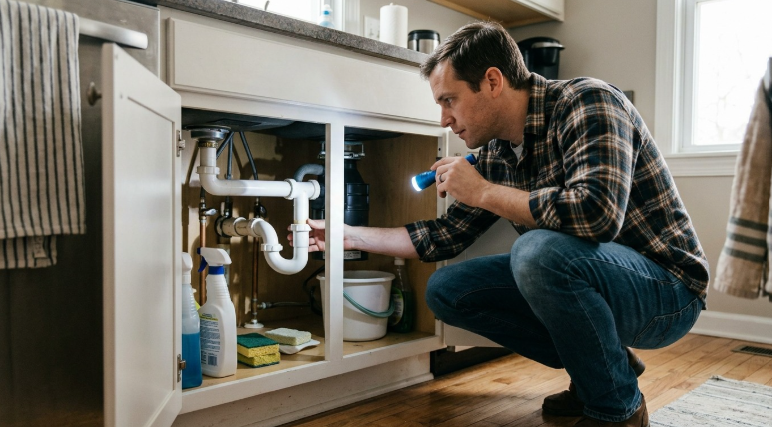
Plumbing issues often present themselves as minor problems. A leaking tap, slow drain or unexpected change in the force of a water flow may develop into something more serious than first anticipated. Knowing what to do in response to the common warning signs helps the owner avoid excessive water waste and the resulting damage to other possessions. Routine maintenance and plumbing inspections contribute to a home’s comfort and security.
Additionally, having an understanding of how the plumbing work covered by Browns Plumbing can help a homeowner in responding appropriately to the issue revealed during the inspection and making informed decisions about the repairs required at present or in the future.
1. Look for Water Pressure Issues
Water pressure impacts on the majority of a home’s plumbing fixtures. A homeowner should take a closer inspection if they suspect an increase or decrease in the water pressure supplied to a certain appliance, tap, or shower.
Insufficient pressure could be caused by a partially closed shut-off valve, the buildup of minerals in a standard faucet aerator, a leak or a problem with the overall supply. On the other hand, a spike in the pressure may put an unnecessary strain on the pipes and related fittings, creating additional points of potential failure. The easiest way to begin troubleshooting is to note if the pressure change only impacts a certain water source.
- If the pressure is low in a single faucet, examine the aerator at the tip for signs of mineral deposits;
- if the pressure is changed across multiple taps, it may have been impacted by outside work;
- If no outside work has been done, check nearby fixtures and drains for signs of leakage.
After completing this simple checklist and finding no obvious issues, a homeowner should call in a plumber to investigate the matter further. Do not attempt any pressure regulation tasks not fully understanding how such changes can impact the system’s integrity.
2. Be Alert to Developing House Water Leaks
Leakage within the walls cannot always be seen easily. A water leak can occur virtually anywhere within the walls, beneath it, and around all sorts of plumbing fixtures, creating damage and significantly increasing the water bill.
Apart from wet patches, damp smell and peeling paint, the signs of water leakage can also include swollen floorboards (the sign of water damage) and a substantially increased water bill with no apparent reason.
What to check
The most common places to begin are exposed pipes. Check beneath the sinks and the washing machine for water dampness, the condition of soldered joints, the absence of mineral deposits, and hose integrity. As an additional test (if the plumbing’s configuration allows for it), read the water meter to confirm no unexpected water usage. It can be helpful to remember to turn off all water sources and appliances that use it before leaving the house, then reading the meter again to compare the numbers.
What to avoid
Some homes share a single water supply, have irrigation systems, and other appliances that may affect the meter’s reading and create false positives as the signs of water leakage from within the walls. Always locate the source of the issue before attempting to reach it through the interior walls of a home. If there is a possibility of a hidden leak, it may be helpful to leave the investigation to professionals to avoid potentially dangerous attempts at identifying the issue.
3. Address the Slow Drains and Backups
One of the most routine household plumbing issues is a slow drain; both kitchen and bathroom fixtures can and will become affected. Kitchen drains often become narrowed by the buildup of fats and residues, while the bathtub and shower drains are more common to be blocked by hair and soap deposits.
A slow drain does not necessarily mean that it is completely blocked – the issue can be in the gradual narrowing of the pipes’ diameter. Several simple measures can be taken to prevent the formation of major blockages in a sink or bathtub:
- • install strainers in the drains to capture hair
- • throw kitchen fat away instead of pouring it down a disposal or a drain
- • remove any visible material accumulated in the sink strainer and drain regularly
- • do not flush anything other than water and short toilet paper down the toilet
- • clean the sink stopper regularly.
Some chemical drain cleaners may not be compatible with the local water supply, create harmful splash-backs or be generally hazardous due to improper application. If multiple drains on a property have slowed recently, or if a backup appears from another fixture, it makes sense to consult a local plumber rather than trying to unclog each drain separately.
4. Investigate the Cause Behind the Constant Noise of a Running Toilet
A consistently running toilet should be examined as its tank’s mechanism fails to ensure the continuous flow of water after a flush. A faulty fill valve, a broken flapper or a broken float adjustment can all be an issue, although the fix may be simple and inexpensive. Once the tank is open, a closer inspection of the overflow tube should be carried out to determine if there is movement of the water flow in it or a faulty flapper. Despite some parts being cheap, it is essential to match these parts with ones appropriate for a specific toilet. A homeowner should not force obstructed fittings or over-tighten the plastic connections. If a toilet is leaking around its base, rocking, or constantly running, double-check if it is a problem with the tank, or an alternative issue.
5. Listen out for Unusual Sounds Coming From Pipes
A loud plumbing-related issue can usually be detected from a distance before a closer investigation. A plumbing system’s typical noises may range from gurgling, whistling, or rattling, each an indication of potential problems to be found.
- Banging – Sudden movement of the pipes caused either by a rapid shutting-off of water or by the lack of a proper counterbalance in the expansion system. This can lead to a water hammer phenomenon and cause loud noises.
- Whistling – A valve that continues restricted or is partially blocked by mineral or foreign deposits in the inner edges of fittings.
- Rattling – The movement of the unrestricted pipes against an external surface.
- Gurgling – Movement of air through unplugged fixtures and venting pipelines that can fail if these components are obstructed.
These issues can be a result of many various factors, but a knowledgeable expert can localize and fix the cause. The time and location of the unusual noise also help in the task of plumbing diagnostics. Do not open and attempt to secure the pipeworks that are hidden behind the interior walls without localizing the problem first.
Most often, persistent booming or pressure changes and associated leakage must be resolved by a professional plumber. If the pressure surges and recedes quickly, and some of the pipe’s sections exhibit odd noises, then the same professional advice applies to all issues.
6. Respond to Emergency Plumbing Situations Appropriately
Some plumbing troubles call for a more urgent response than others. A persistent drip from one or two faucets can wait for a few hours while a leaking pipe, ruptured pipe, sewage backup, or complete loss of water pressure cannot be ignored.
In the case of a ruptured pipe or a serious leak:
- • if the isolation valve of the fixture is accessible and within the reach, attempt to close it
- • if necessary, turn off the main water supply to the house
- • move people and items away from the water-accessible devices in the near vicinity
- • if possible, move the other property items from the danger zone
Call an emergency plumbing service if water has come close to electrical apparatus or outlets. It may be unsafe to visit the area or attempt to operate with any electricity in this area. If sewage has appeared and there are children and pets in the house, leave them in a secure area and avoid getting in direct contact with wastewater.
7. Preventive Plumbing Maintenance
Preventive plumbing maintenance ensures that the first signs of wear and tear are noticed before the need arises for expensive repairs. A homeowner does not need to check all of the home’s fixtures every single day. Instead, they can use a series of simple periodic checks to avoid serious and costly plumbing troubles.
Checks that can be made every month:
- • look under the sink for signs of dampness
- • check that taps and showerheads do not leak
- • listen for running toilets
- • examine exposed appliance hoses to ensure that they are not cracked or bulging
- • make sure that the drains clear as they are supposed to
The periodic checks that can be made every season
Before the cold season, ensure exposed water pipes are insulated if possible. Do not forget that insulation does not guarantee the pipes are unbreakable and not subject to frost damage.
Warm the interior spaces, seal the draft, and avoid exposing delicate areas to the cold weather. In the event of a frozen pipe, refrain from attempting to de-frost the pipe with the naked flame – call a professional and explain that the affected section of a pipe is inaccessible, faulty, or otherwise impossible to be addressed with the tools that may be available. Additionally, locate and familiarize oneself with the household’s main water shut-off valve to be ready to utilize it in time if necessary.
Conclusion
Although plumbing systems tend to warn their owners about significant problems by showing minor irregularities beforehand, such warning signs are not always obvious. The water pressure changes, water leaks, slow drains and backups, and unusual sound from water pipes – should always be carefully examined. However, the prevention methods are often effective, as long as they are not complicated and require only a minimal amount of effort to be undertaken on a routine basis.
A household plumbing fixtures regular maintenance includes keeping the toilet from running, avoiding using any unnecessary materials in the sink drains, and checking the exposed pipes for abnormalities every now and then to catch serious issues prior to their emergence. The warning signs that seem unusual might be the source of serious plumbing problems in the future. The homeowners must be mindful to respond promptly to any suspicious plumbing developments, including water leakages, pressure failures, or sewage accumulation. All of these issues will help a homeowner keep the home safe and water waste-free. Read More at Decoratoradvice com


