Every year, design publications flood the internet with trend lists. Most of them read like the same article reshuffled — new year, same buzzwords. But 2026 is genuinely different in a few ways worth paying attention to.
The interior décor trends gaining real traction this year aren’t about chasing novelty. They’re pulling in the opposite direction: slower, more personal, more durable. Homeowners are tired of redoing rooms every two years because something went out of style. The shift toward materials that age well, palettes rooted in nature, and furniture built to last isn’t a passing phase — it reflects something deeper about how people want to live right now.
This article covers the 2026 interior décor trends that are actually worth trying — not because they’re popular on social media, but because they work in real homes. You’ll find out which directions have staying power, which ones are already fading, and how to bring any of these into your space without starting from scratch.
Which Interior Décor Trends Are Defining 2026?
The clearest through-line across this year’s design direction is restraint. Not minimalism exactly — more like intentionality. Less buying, more choosing. The trends below reflect that shift.
| Trend | Key Characteristic | Who It Works For |
|---|---|---|
| Warm Minimalism | Soft neutrals, natural textures, uncluttered | Small spaces, rentals |
| Earthy Palette Dominance | Ochre, terracotta, clay, moss | Any home needing warmth |
| Reclaimed & Vintage Materials | Worn wood, patinated metals, second-hand finds | Budget-conscious decorators |
| Soft Organic Shapes | Curved sofas, rounded tables, arched mirrors | Living rooms, bedrooms |
| Layered Lighting | Multiple sources, warm temperature, dimmers | Every room |
| Biophilic Design | Plants, natural light, organic materials | Urban homes especially |
6 Interior Décor Trends Worth Trying in 2026
1. Warm Minimalism (Not Cold, Not Cluttered)
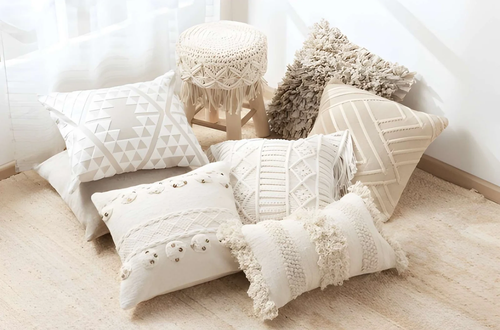
The stark white minimalism of the early 2010s has been fading for a while. What’s replacing it isn’t maximalism — it’s warmth. Think cream-toned walls, linen upholstery, unfinished wood, and rooms that breathe without feeling empty.
The appeal is practical: warm minimalism is forgiving to live in. It doesn’t punish you for a throw blanket left on the couch. It ages better than trend-heavy rooms. And it photographs beautifully, which helps if you ever sell.
2. Earthy, Nature-Rooted Palettes
Terracotta had a long run and it’s not done yet — but the palette has expanded. In 2026, the colors getting the most traction are clay, ochre, warm moss, dusty sage, and deep sand. These are colors that work together almost automatically, which makes them low-risk to try.
The easiest entry point is textiles. A moss-green throw, ochre cushions, or a clay-toned ceramic lamp shifts the color temperature of a room without a commitment.
3. Reclaimed Materials and Visible Wear
New furniture that looks old is everywhere. Actual old furniture is better. The 2026 trend toward reclaimed wood, vintage finds, and materials with visible history isn’t just aesthetic — it’s a response to how disposable the home décor market became.
A secondhand sideboard with worn edges has a presence that flat-pack alternatives rarely match. It also costs less, often, and won’t end up in a landfill in three years.
4. Soft, Organic Shapes
Hard edges are out. Curved sofas, rounded armchairs, arched doorframes, circular mirrors — these shapes consistently make rooms feel more welcoming. There’s research behind this: humans instinctively read sharp angles as threatening and curves as safe. Designers have known it for decades. It’s just taken a while to filter down to mainstream retail.
You don’t need new furniture to try this. An arched mirror, a round coffee table, or a curved bench can introduce the shape language without replacing anything major.
5. Layered, Intentional Lighting
Single overhead fixtures are a design dead-end. The rooms that feel best in 2026 use light the way good restaurants do: multiple sources, all warm-toned, all dimmable if possible.
Floor lamps, table lamps, candles, and accent lighting working together create depth. The overhead fixture becomes a last resort rather than the default. This is one of those changes that costs relatively little and makes an outsized difference in how a room feels at night.
6. Biophilic Design (Done Simply)
Biophilic design — incorporating nature into interior spaces — gets overcomplicated in trend coverage. Living walls and botanical murals are fine, but they’re not the point. The point is natural light, plants that actually live in the room, materials that come from the earth, and views that connect interior to exterior where possible.
Even one large plant in a corner and a shift to linen or wool textiles moves a room in this direction. You don’t need an interior renovation. You need less synthetic material and more of what grows.
2026 Trend Longevity: What Stays, What Fades
| Trend | Longevity Outlook | Reason |
|---|---|---|
| Warm Minimalism | Long-term | Functional, livable, not dependent on novelty |
| Earthy Palettes | 3-5 years | Broad enough to evolve without a hard reset |
| Reclaimed Materials | Long-term | Sustainability pressure isn’t going away |
| Organic Shapes | 2-3 years | Already peaking in retail saturation |
| Maximalism / Cluttercore | Fading | Backlash building; feels exhausting to maintain |
| All-White Everything | Faded | Already replaced by warm neutrals |
| Matching Furniture Sets | Faded | Looks dated; layered looks outperforming |
FAQ
What is the biggest interior décor trend for 2026?
Warm minimalism and earthy, nature-rooted palettes are the two most consistent directions across design coverage and retail for 2026. Both prioritize longevity over novelty.
Are earthy tones still in style for 2026?
Yes, and the palette has expanded. Terracotta remains relevant, but clay, ochre, moss, and warm sand are getting more attention this year.
What décor trends are going out of style in 2026?
Cool gray palettes, all-white interiors, matching furniture sets, and the hard-edge industrial aesthetic are all fading. Cluttercore had a short run and is already in retreat.
How do I try 2026 interior décor trends without redecorating?
Start with textiles and lighting. Swap throw pillows for earthy tones, add a floor lamp, bring in one plant, and replace cool-white bulbs with warm ones (2700K). That combination touches four of the major 2026 directions at once.
Is vintage furniture a good investment in 2026?
For style longevity, yes. Vintage and reclaimed pieces hold up better through trend cycles than fast-furniture alternatives, and the secondhand furniture market has expanded significantly, making quality finds more accessible than a few years ago.
Bottom Line
The interior décor trends worth trying in 2026 share one quality: they make rooms better to live in, not just better to photograph. Warm minimalism, earthy palettes, reclaimed materials, soft shapes, layered lighting, and biophilic elements all pull toward spaces that feel personal and durable rather than seasonal and disposable.
You don’t need to adopt all of it. Pick one direction that fits how you actually use your home, start with the smallest possible change — a bulb swap, a plant, a secondhand piece — and build from there. The best-decorated rooms in 2026 aren’t the ones that chased every trend. They’re the ones that chose a few things and committed.
For more interior decor trends must visit https://decoratoradvice.ca/