
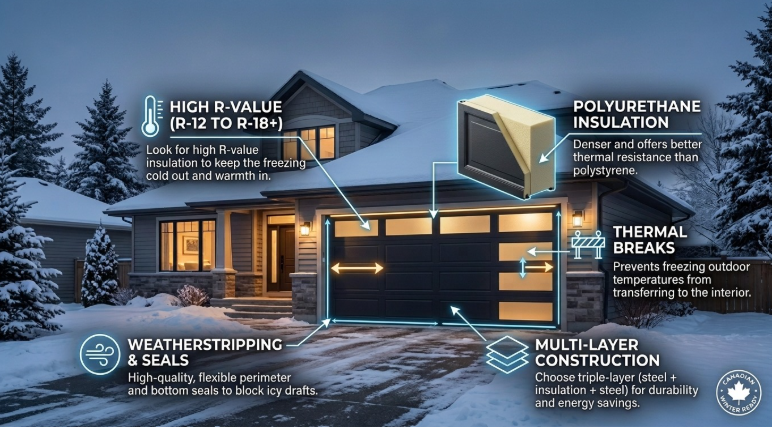
A garage door can serve a variety of purposes, apart from securing the vehicles and other objects stored within the garage. Moreover, it can significantly contribute to the comfort and energy efficiency of the room and the house in general. The residents of Canada, in particular, should pay special attention while purchasing a new garage door, as a considerable part of the country is located in the zone, where the temperature rarely rises above freezing point. An inappropriate choice of a garage door might lead to additional expenses related to poor heat isolation and uncomfortable indoor climate. A basic knowledge of garage door insulation, materials, weather seal, and installation will help the buyer make the right choice.
To begin with, the buyer should study the garage door specs before heading to the showrooms and comparing the models and their prices. According to the website Titan Overhead Door, home garage doors can differ in terms of insulation, construction, and design. Studying the characteristics of the doors will help the customer identify the mechanical advantages of one model over another. In the end, the appropriate choice of garage door will contribute to the improvement of the comfort level and eliminate potential problems.
1. Understand Why Garage Door Insulation Matters
Heat always moves from the area with a higher temperature to the area with a lower temperature through conduction and convection. Thus, an insulated garage door should prevent the loss of warm air from the house and the penetration of cold air into the garage. However, the isolation of doors is only a small part of the multi-layered defense against the cold weather. The condition of the garage itself, as well as the adjacent rooms, plays an equally important role.
The garage door isolation largely depends on the intended use of the structure.
- Attached garage: doors with insulation will eliminate the difference in temperature between the house and the garage.
- Workshop: an insulated garage door will allow the completion of various tasks with ease.
- Garage with plumbing: the maintenance of temperature will reduce the risk of frozen pipes, though it is unlikely to eliminate it completely.
- Storage: doors with a high level of insulation will create stable conditions for storing different items.
The customer should keep in mind that it will not be possible to transform an uninsulated garage into a room with a constant temperature using only the insulated garage door.
2. Learn How Garage Door R-Values Work
Among garage door specifications, the first thing that should attract the attention of a customer is the R-Value, which represents the ability of the garage door to resist heat flow. Thus, the higher the R-Value, the better the garage door insulation will be, as it eliminates heat loss through conduction and minimizes heat loss through convection.
An R-12 door, for example, will provide twice the isolation of an R-6 door, assuming that the R-Value numbers are comparable.
However, there is one subtlety that the buyer should be aware of while studying garage door insulation ratings. The R-Value of a single panel and the R-Value of a whole door installation rarely coincide with each other, as the calculation of the former is based on different principles. The customer should carefully read the accompanying documentation and pay attention to the specifics mentioned by the producers.
Prior to analyzing the R-Value garage door specs, the buyer should ask himself the following questions:
- Is the R-Value referring to an individual panel or an entire door?
- What kind of insulation does the manufacturer use?
- What features does the door have that reduce heat loss due to convection?
- Do the specs contain sufficient information about the method and how the score was achieved?
- Are the weather seals included, and how tight is the fit?
Only after answering these questions, will it be possible to determine whether two garage doors are comparable in terms of R-Value and thermal insulation.
3. Choose a Garage Door Material
Speaking of garage door materials, each of the existing options has its own set of advantages and disadvantages. Paying attention to the climate, the buyer’s expectations, the house location, and the architectural structure will help choose the material that meets all the criteria.
Steel garage doors
Steel is a durable and strong material that is available in a variety of colors and requires relatively low maintenance. An insulated steel door can have a layer of isolating material, which is highly resistant to temperature fluctuations, between the external steel layer and the internal one. The thickness of the steel material is not the sole indicator of the door’s ability to maintain a stable temperature. More important, in this case, is the material of the inner layer, construction, and additional features, such as weather stripping.
Aluminum garage doors
Aluminum doors are light, relatively strong, and perfect for contemporary-style houses. Some aluminum garage doors even allow increasing the amount of natural light by incorporating large glass panels. Metal and glass, however, are excellent heat conductors, which means that the garage will not remain significantly warmer than the adjacent rooms. In this case, the customer should pay a particular attention to the total thermal performance specs.
Wood garage doors
Garage doors made of wood are aesthetically pleasing, provide superior isolation, but require more maintenance. The buyer should carefully consider all the implications and the budget before selecting this option.
4. Check the Weather Seals Before Winter Arrives
An insulated garage door is not completely useless if a small amount of cold air penetrates through the edge of the door. Seals are needed to ensure that the cold air cannot penetrate through the edges of the door. The customer should take a closer look at the following features of the weather seal to ensure that they are in good condition:
- The bottom edge: look for cracks and depressions; make sure that the distance between the floor and the edge of the door is minimized.
- Side edges: examine the rubbers for damage and/or looseness; make sure that the sides of the garage door are not deformed and do not allow the air to penetrate.
- Top edge: ensure that the top of the garage door fits snugly against the header.
- Joints: inspect the state of the joints between individual sections.
- The alignment of the door: check whether the door is twisted, which will cause irregular gaps on the sides and at the top.
The presence of daylight around the garage door indicates poor isolation and improper door installation. It is not recommended to attempt to fix the torsion springs of a garage door by oneself. Instead, the customer should replace the door seal with a high-quality one and call an expert in case of misalignment.
5. Consider the Garage Door Design
Despite the functional focus on the garage doors, the overall appearance of the garage door is still a decisive factor for many buyers. The combination of materials and design can have an enormous effect on the ability of the garage to maintain the temperature with minimal heat loss and required maintenance.
Insulated doors usually have a construction feature that allows them to open horizontally and consist of several panels. Sectional doors, in particular, are known to provide excellent isolation due to the use of multiple panels. Insulated garage doors can have different types of thermal isolation made of various materials. For this reason, the buyer should pay attention to the structure of the selected door.
Important considerations:
- Construction: pay attention to the specific features of the construction of the isolating core and the material of the panel.
- Thermal break: doors have built-in features that prevent heat transfer from one side of the garage to the other side.
- Joint construction: interlocking edges and proper weather stripping seals prevent excessive loss of warm air.
- Hardware: make sure that the hardware parts of the door are of high quality and allow the door to function properly.
- Surface finish: a high-quality painting can prevent corrosion and other damage caused by the weather.
Individually, none of the elements mentioned above guarantee the high level of performance and the overall durability of the garage door. The door is a sophisticated mechanism, where the combined impact of all the details determines the level of customer satisfaction.
6. Make Sure the Door Fits the Garage Opening
An improperly sized door with an excellent R-Value can fail to meet the buyer’s expectations due to the wrong size. The buyer should understand that measuring the garage door is only a part of the preparation process, as the installers should ensure that the door fits the opening. Apart from the primary size, the installers should consider the clearance and other factors.
The following details should be taken into account:
The width and height of the opening: although the size of the opening is not the determining factor, the installers should assess the clearance above and alongside the garage door. The height of the ceiling and the presence of any objects inside the garage that could interfere with the installation should also be taken into account.
- Clearance: Make sure that the opening has the required amount of headroom, side room, and clearance.
- The condition of the frame: inspect the frame to ensure that it is compatible with the selected garage door.
- Lighting and other objects: take into account the placement of lights and other potential obstacles.
- Tracks and opener: make sure that the selected garage door is compatible with the tracks, openers, and other accessories.
Professionals who are involved in the installation process can advise the buyer on the necessary size and eliminate potential problems caused by the wrong size of the garage door.
7. Choose a Door Opener that Matches the Door
An opener should meet the requirements of the door and the local building regulations. A heavier insulated door, for example, will require a certain amount of power to be opened. At the same time, a higher degree of isolation does not necessarily indicate the motor that a buyer should choose.
Important considerations:
- Lifting capacity: make sure that the torque of the opener matches the specifications of the garage door.
- Level of noise: belt drive openers, for example, are ideally suited for attached garages due to their low level of noise.
- Safety sensors: modern openers use photo-cell technology to ensure the safety of people and pets.
- Manual operation: become acquainted with the procedure for the manual operation of the garage door.
- Maintenance: follow the manufacturer’s recommendations regarding the maintenance of the garage door opener.
Properly maintained garage doors allow for uninterrupted operation throughout the year. A properly balanced door rarely requires manual opening or adjustment of the spring tension. The problems that are associated with the excessive weight of the door, interference of objects, or the reverse movement of the garage door should be resolved by calling an expert.
8. Prepare Your Garage Door for the Cold Season
Proper maintenance of the garage door is crucial; it allows the homeowner to eliminate potential problems and ensure the stable performance of the garage door during the winter season. The following procedures can help the buyer complete the basic garage door maintenance.
- Visual inspection: look for any damaged or deformed parts, problems with the weather seal, loose hardware, rust, and other issues.
- Cleaning: remove any foreign objects, such as leaves or dirt, that can interfere with the proper functioning of the garage door. Avoid lubricating rollers or other parts if the manufacturer explicitly recommends against it.
- Opener safety test: perform the safety test that is recommended by the opener manufacturer. Avoid staying near the door while conducting the test or operating the door opener.
Doors have strong torsion springs and cables that are under high pressure. Only a professional can perform any maintenance or repair work on the garage door. It might also be helpful for the buyer to inspect the overall garage insulation. Other measures, such as weather stripping around windows, wall insulation, and ceiling insulation of an uninsulated area, will improve the performance of the door.
Conclusion
The main criterion for buying an energy efficient garage door is a thorough consideration of the isolation, construction, weather stripping, and installation process. The customer should give preference to doors that have an adequate degree of isolation, are made of materials that are resistant to extreme temperatures, have an appropriate R-Value, and come with a high-quality weather seal. Following the recommendations regarding maintenance will increase the service life of the garage door and reduce the number of repairs. The basic knowledge of garage doors can be extremely useful to a homeowner in Canada, as it will help avoid additional expenses during the winter season. Read More at Decoratoradvice com