Walk into a room that works and something feels settled about it. Nothing is competing for attention. Nothing feels heavy on one side and empty on the other. The furniture and décor exist together without tension. That quality — balance — is what separates a room that looks designed from one that looks assembled.
Most people assume balance means symmetry: matching lamps on either side of the bed, identical chairs flanking the fireplace, everything in pairs. Symmetry is one way to achieve balance, but it’s the least interesting way and often the most expensive. Real balance in furniture and home décor is about visual weight — the way the eye reads the heaviness or lightness of objects, colors, shapes, and textures across a space. You can balance a large dark sofa with a grouping of lighter objects. You can balance a tall bookshelf with a wide low console. You don’t need matching pieces to get there.
This guide covers exactly how to create a balanced look with furniture and home décor: the principles behind it, the specific mistakes that throw rooms off, and the practical decisions that bring everything into alignment without starting from scratch.
What Does Visual Balance Actually Mean in a Room?
Balance in interior design refers to how visual weight is distributed across a space. It’s perceived, not measured — the eye reads certain things as heavier than others, and when that weight is unevenly distributed, something feels wrong even if the viewer can’t name it.
| Element | Reads as Heavy | Reads as Light |
|---|---|---|
| Color | Dark, saturated tones | Pale, muted, warm neutrals |
| Size | Large, bulky pieces | Small, slim, open-frame pieces |
| Texture | Rough, dense, layered | Smooth, sheer, minimal |
| Shape | Angular, geometric forms | Curved, organic shapes |
| Pattern | Bold, high-contrast prints | Subtle, tone-on-tone patterns |
| Material | Stone, dark wood, metal | Glass, pale wood, linen |
Understanding this table is most of the work. Once you can read visual weight, you can move things around — literally and figuratively — until the room feels settled.
How to Create a Balanced Look With Furniture and Home Décor
1. Understand the Three Types of Balance
Symmetrical balance is the most obvious: mirror one side of the room with the other. It’s formal, orderly, and easy to execute. Two matching nightstands, a sofa centered on the wall with identical end tables — classic symmetrical arrangements. They work, but they can feel static.
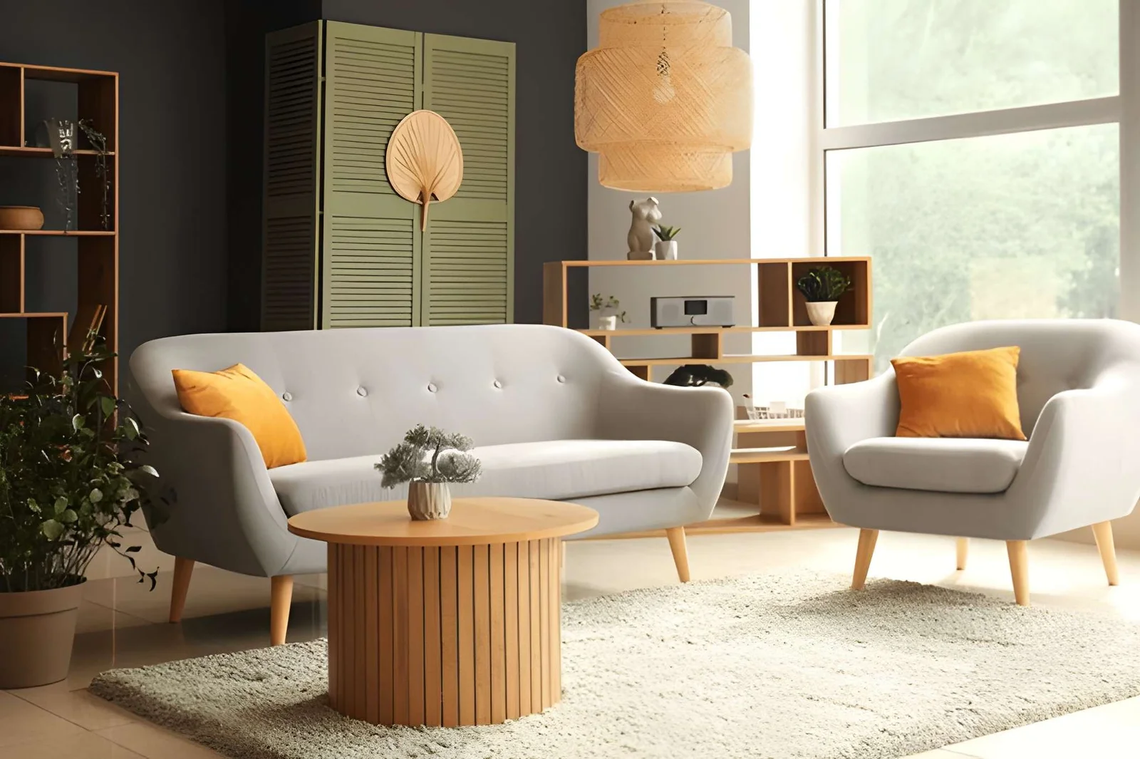
Asymmetrical balance is more dynamic and more interesting. A large armchair on one side balanced by a floor lamp plus a side table on the other. A tall bookcase balanced by a wider, lower credenza. The visual weights are equal even though the objects aren’t identical.
Radial balance organizes elements around a central point — a round dining table with chairs, a circular rug with seating arranged around it. It creates natural flow and works especially well in dining rooms and open-plan spaces.
Most well-designed rooms use all three types in different areas rather than committing to one throughout.
2. Anchor Each Area With One Dominant Piece
A room without a clear anchor point feels directionless. The eye doesn’t know where to land, so it keeps moving — which reads as restless and unresolved. Every seating area, bedroom, and dining space needs one dominant piece that everything else responds to.
In a living room, that’s usually the sofa. In a bedroom, the bed. In a dining room, the table. Everything else — chairs, lamps, rugs, art, accessories — should be chosen and placed in relationship to that anchor rather than independently. When pieces are chosen in isolation and then brought together, balance is accidental at best.
3. Distribute Visual Weight Across the Room
This is the core practical skill. Scan any room and identify where the visual weight is concentrated. A dark leather sofa, a heavy wooden coffee table, and a large dark bookcase all on one side of the room creates a lopsided feeling that no amount of accessory styling will fully fix.
The solution is distribution: move a heavy piece to the opposite side, or counterbalance it with multiple lighter elements. A large dark sofa can be balanced by pale walls, light-toned rugs, and slim furniture on the opposite side. You’re not moving weight — you’re redistributing how the eye reads it.
4. Use Color to Balance, Not Just Decorate
Color carries significant visual weight and is one of the most flexible balancing tools available. A dark accent color introduced in one corner of a room needs to appear somewhere else — a pillow, a vase, a book spine — or that corner will feel isolated and heavy.
The practical rule is that any color that appears in a room should appear in at least two places, ideally at different scales. A terracotta rug echoed in a small terracotta ceramic on a shelf. A navy throw pillow echoed in a piece of art across the room. This repetition creates the visual circuit that makes rooms feel cohesive rather than randomly assembled.
5. Mix Heights to Create Vertical Balance
Rooms where everything sits at the same height feel flat. A sofa, coffee table, and console all at similar heights with nothing taller creates a visual plateau that lacks energy. Rooms that feel balanced and interesting use a variety of heights: tall bookshelves or floor lamps, mid-height furniture, low coffee tables, and objects at different levels on surfaces.
The general guidance is to create a visual triangle — if you drew lines connecting the tallest, mid-height, and lowest points in a seating arrangement, you’d want something close to a triangle rather than a flat line. This principle applies to table styling, shelf arrangements, and full room layouts equally.
6. Edit for Balance, Not Just Style
One of the most overlooked aspects of creating a balanced look with furniture and home décor is what gets removed rather than added. An overloaded room can’t achieve balance because there are too many competing visual weights pulling in too many directions.
The discipline is editing: identify the pieces that are adding visual noise without contributing to the balance of the room and remove them. A side table with seven objects creates clutter. The same table with two or three objects, chosen for their relationship to each other in weight and height, contributes to the room’s balance rather than undermining it. The right approach to furniture arrangement always includes subtracting before adding.
Balance Checklist: Room-by-Room
| Room | Common Imbalance | Quick Fix |
|---|---|---|
| Living Room | All heavy furniture on one wall | Move one piece across, add tall lamp opposite |
| Bedroom | Bed dominates, nothing balances opposite wall | Art or mirror centered on facing wall |
| Dining Room | Table too large or too small for rug | Rug should extend 24″ beyond table all sides |
| Hallway | Linear, no visual rest points | Alternate wall art heights, add console |
| Home Office | Desk heavy, rest of room empty | Bookshelf or plant to balance desk wall |
| Open Plan | Zones blur into each other | Rugs and lighting to define each area |
FAQ
What is the difference between symmetrical and asymmetrical balance in home décor?
Symmetrical balance mirrors elements on either side of a central axis — identical lamps, matching chairs. Asymmetrical balance achieves the same visual equilibrium using different objects of equivalent visual weight. Both work; asymmetrical tends to feel more relaxed and dynamic.
How do you balance a room with mismatched furniture?
Focus on color repetition and visual weight distribution rather than matching styles. Repeat accent colors across the room, vary heights intentionally, and make sure no single area carries all the visual weight. Mismatched furniture with coherent color and proportion reads as curated, not chaotic.
Can you have too much balance in a room?
Yes — pure symmetry can feel rigid and sterile. The most interesting rooms have a clear underlying balance with deliberate points of asymmetry or surprise. A mostly symmetrical bedroom with one unexpected element on a nightstand, for instance, feels intentional rather than showroom-generic.
How do rugs help with room balance?
A properly sized rug anchors the furniture arrangement and defines the visual center of gravity for the room. It distributes weight horizontally across the floor plane, which grounds everything above it. An undersized rug creates a visual island that disconnects from the rest of the space.
What’s the fastest way to rebalance a room that feels off?
Stand in the doorway and identify where your eye goes first and where it stops moving. The stopping point is where visual weight is concentrated. Either redistribute what’s there or add counterbalancing elements on the opposite side. Often moving just one or two pieces resolves the imbalance entirely.
Bottom Line
Creating a balanced look with furniture and home décor is less about following rules and more about training your eye to read visual weight. Once you can see why a room feels heavy on one side or flat throughout, the fixes become obvious. Distribute weight across the space, anchor each area with one dominant piece, repeat colors intentionally, vary heights, and edit down to what’s actually contributing.
Balance isn’t a destination — it shifts as you add and remove pieces. But the rooms that consistently feel right are the ones where someone paid attention to how visual weight was moving through the space and made deliberate choices in response. That attention is what makes a room feel designed. And it costs nothing to develop.
For more furniture and home decors must visit https://decoratoradvice.ca/