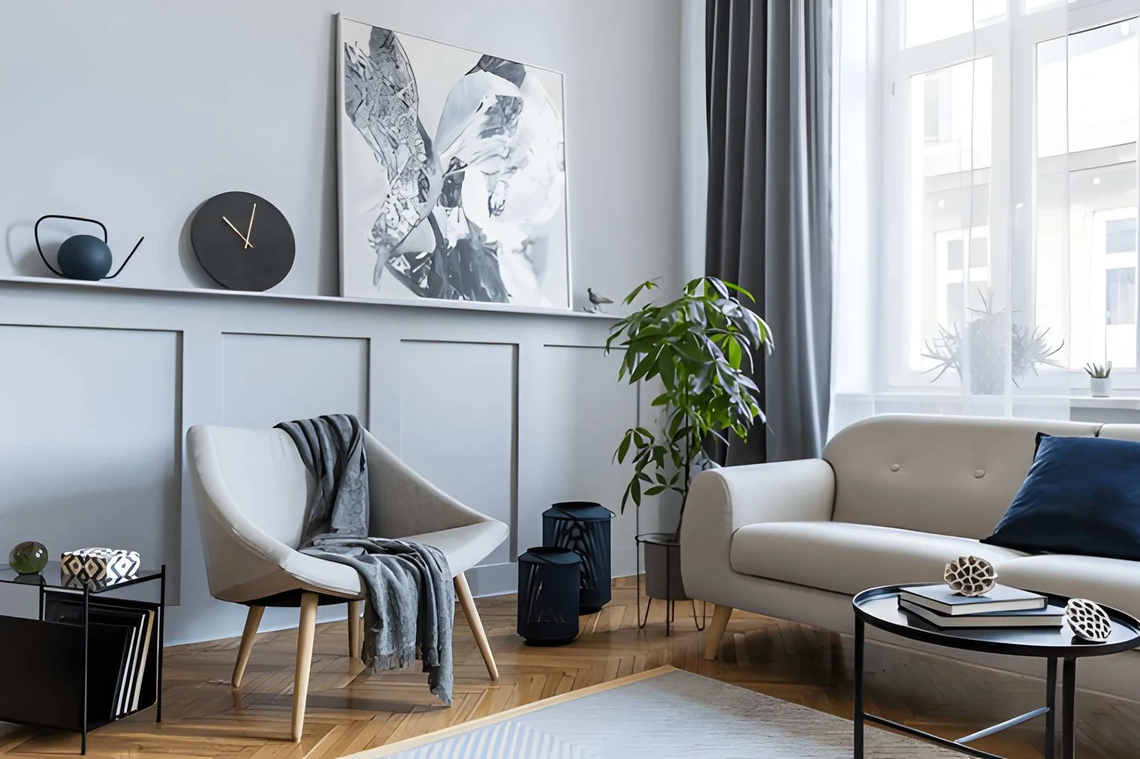
Minimalism has been one of the most influential ideas in US home design for the better part of a decade. It arrived with compelling logic: too much stuff creates stress, visual clutter overwhelms the brain, and clearing the physical environment clears the mental one. The promise of the minimalist home — calm, clarity, freedom — landed with particular force in a culture that felt increasingly overwhelmed by accumulation.
Millions of Americans have pursued it to varying degrees. They’ve donated furniture, cleared countertops, built capsule wardrobes, and organized what remained according to principles that prioritize function and visual simplicity over warmth and personal accumulation. Some found exactly what they were looking for. Others created spaces that looked clean in photographs and felt empty in daily life — and couldn’t quite explain the gap between what they expected and what they experienced.
The honest answer to whether a minimalist home makes people happier is more nuanced than the movement’s advocates usually admit. The research is real, the benefits are genuine for some people, and the costs are equally real for others. This article examines both sides without agenda — what the evidence actually shows, who benefits most, who doesn’t, and how to find the right version of simplicity for your specific personality and household.
What the Research Actually Says About Minimalist Homes and Wellbeing
The psychological case for minimalism rests on solid research — specifically the documented relationship between clutter and stress. A landmark 2010 study published in Personality and Social Psychology Bulletin found that women who described their homes as cluttered showed elevated cortisol patterns throughout the day. The clutter was functioning as a persistent background stressor.
That finding is real. The question is whether a minimalist home is the only or best response to it.
| Research Finding | What It Actually Shows | What It Doesn’t Show |
|---|---|---|
| Clutter elevates cortisol | Disorganized accumulation creates stress | That minimalism is required — organization matters more than quantity |
| Visual complexity affects focus | High visual stimulation reduces concentration | That simplicity is universally preferable — some personalities focus better with stimulation |
| Sparse environments affect warmth perception | Empty spaces read as cold and unwelcoming | That minimalism can’t be warm — material quality resolves this |
| Nature elements reduce stress | Plants and natural materials improve mood | That minimalism and nature connection are compatible — they are |
| Personal objects support identity | Meaningful objects contribute to psychological security | That more objects are better — quality and meaning matter more than quantity |
The research supports reducing disorganized clutter. It doesn’t universally support the aesthetic of visual emptiness that the minimalist home movement often produces.
Who Actually Benefits From a Minimalist Home
The people who report genuine, sustained happiness improvement from adopting a minimalist home share consistent characteristics. Understanding who they are helps clarify whether minimalism is the right direction for you or a borrowed framework that doesn’t fit.
Minimalism genuinely helps:
People who are highly sensitive to visual stimulation — who find busy, object-dense environments activating rather than comforting. People whose stress is genuinely driven by the cognitive burden of managing many possessions. People who find maintenance of objects time-consuming and the reduction of that maintenance meaningfully liberating. People who respond to visual calm as aesthetically satisfying rather than as deprivation.
Minimalism often doesn’t help:
People who find richly layered environments warm and comforting rather than overwhelming. People whose identity and personal history are meaningfully expressed through collected objects. Families with children, whose daily reality produces entropy that minimal aesthetics can’t absorb without constant effortful maintenance. People who mistake visual emptiness for psychological clarity and find the former doesn’t reliably produce the latter.
| Personality Type | Likely Response to Minimalist Home | Better Approach If Not a Fit |
|---|---|---|
| Highly stimulation-sensitive | Very positive — stress reduction significant | Full minimalism appropriate |
| Collector and accumulator | Often negative — loss of identity expression | Curated maximalism — edit, don’t eliminate |
| Family with young children | Frustrating — impossible to maintain | Organization systems, not minimalism |
| Creative professional | Mixed — may reduce stimulation needed for work | Minimal in personal spaces, rich in work spaces |
| Introvert needing retreat | Positive in private spaces | Minimalism in bedroom and study, not whole home |
| Social extrovert | May feel cold and unwelcoming to guests | Warm minimalism with emphasis on quality materials |
The Problems With Minimalism That Its Advocates Understate
The Maintenance Paradox
A minimalist home requires more continuous active maintenance than a richly furnished one to look as intended. Every surface in a minimalist home is visible. Every object that arrives — mail, groceries, a child’s school project, a coat dropped on a chair — is immediately visible as a disruption to the intended aesthetic.
A home with more objects and more visual richness absorbs the entropy of daily life more gracefully. The minimalist home looks perfect when it’s perfectly maintained and immediately wrong when it isn’t. For most US households with multiple occupants and normal daily lives, perfect maintenance is not a sustainable state.
The Warmth Deficit
Visual warmth in a home comes from layering — multiple materials, varied textures, objects at different scales, evidence of human habitation. These are the elements that make a space feel like somewhere people live rather than somewhere people manage.
A minimalist home that pursues visual emptiness at the expense of material quality produces spaces that feel cold, echoey, and institutional — a hotel lobby rather than a place to be. The minimalist homes that genuinely feel good to be in are not empty. They’re edited to contain fewer, better objects — which is a different thing.
The Identity Cost
Research on the psychology of possessions — including work by Russell Belk at the Schulich School of Business and Mihaly Csikszentmihalyi on the meaning of objects — consistently finds that personal possessions function as identity anchors and memory supports. They extend the self into the physical environment in ways that support psychological security and continuity.
A minimalist home that eliminates personal objects in pursuit of visual simplicity also eliminates the environmental signals that reinforce personal identity. For people who don’t have strong external identity anchors, this can produce a feeling of groundlessness that the aesthetic clarity doesn’t compensate for.
| Minimalism Benefit | Genuine Evidence | Limitation Worth Knowing |
|---|---|---|
| Reduced clutter stress | Strong — cortisol research is consistent | Organization achieves this without visual emptiness |
| Easier maintenance | True at very low object count | Requires constant vigilance in real households |
| Visual calm | Real for stimulation-sensitive individuals | Can feel cold rather than calm for others |
| Financial saving | True if consuming less | Can shift spending to fewer, more expensive items |
| Environmental benefit | Genuine if consuming less overall | Minimalism sometimes increases quality-item spending |
| Mental clarity | Reported subjectively | Not consistently demonstrated in controlled research |
What Works Better Than Pure Minimalism for Most US Homeowners
The evidence points toward a middle position that most design writing doesn’t articulate clearly: the psychological benefits associated with minimalism — reduced stress, improved focus, sense of control — come primarily from organization and intentionality, not from visual emptiness.
A home with a moderate number of personally meaningful, well-organized objects produces the cognitive benefits of reduced clutter without the warmth deficit of visual emptiness. This is sometimes called “edited maximalism” or “warm minimalism” — but the label matters less than the principle: keep what earns its place, organize what stays, eliminate the genuinely purposeless, and choose quality over quantity without pursuing quantity reduction as an end in itself.
Frequently Asked Questions
Does a minimalist home actually reduce stress?
Reducing disorganized clutter consistently reduces stress — that research is solid. Whether visual minimalism beyond that point produces additional stress reduction depends heavily on the individual. For stimulation-sensitive people, yes. For people who find richness and layering comforting, sparse environments can produce a different kind of discomfort. The research supports organization more universally than it supports minimalism specifically.
Why does my minimalist home still feel stressful?
Several possible reasons: the maintenance required to keep a minimalist home looking intentional may be adding rather than reducing daily cognitive burden. The warmth deficit in a sparse space may be affecting mood in ways that visual clarity isn’t compensating for. Or the personal objects removed in pursuit of minimalism were providing identity and memory support that their absence now lacks. Minimalism is not a universal fix — it’s a specific solution that works well for specific personalities.
Is minimalism right for families with children?
Rarely, as a whole-home aesthetic. Children produce entropy that minimal aesthetics can’t absorb gracefully — and trying to maintain a minimalist home with young children typically creates stress rather than reducing it. Excellent organization systems in children’s spaces, combined with a more richly furnished but well-organized approach in shared spaces, produces better outcomes for most US families than pursuing minimalism throughout the home.
What’s the difference between a minimalist home and a well-organized home?
Organization means everything has a place and returns to it. Minimalism means reducing the number of things to a point where visual sparseness is the aesthetic result. A well-organized home with moderate possessions produces most of the psychological benefits attributed to minimalism without the warmth deficit. For most people, the organized home is the more livable target.
How do I get the benefits of minimalism without the coldness?
Through material quality rather than object reduction. A minimalist home feels cold when it uses inexpensive materials — plastic, particleboard, mass-market objects — because those materials have no visual warmth at any quantity. The same level of visual sparseness with natural wood, linen textiles, handmade ceramics, and warm-toned lighting feels entirely different — edited and considered rather than empty and clinical. Invest in fewer, better things rather than simply fewer things.
The Bottom Line
A minimalist home is not a universal path to happiness. It’s a specific solution that works well for people who are genuinely stressed by visual complexity, who find maintenance liberating rather than burdensome, and who respond to visual calm as aesthetically satisfying rather than as deprivation.
For everyone else — which is most US households — the research supports a different target: a home that’s intentionally organized, edited of genuinely purposeless accumulation, and furnished with quality objects that have personal meaning. That home captures the psychological benefits of reduced clutter without the warmth deficit, the identity cost, or the maintenance burden that pure minimalism imposes.
Less is sometimes more. But enough — the right things, in the right place, maintained well — is usually better than less.
For minimalist home ideas must visit https://decoratoradvice.ca/