
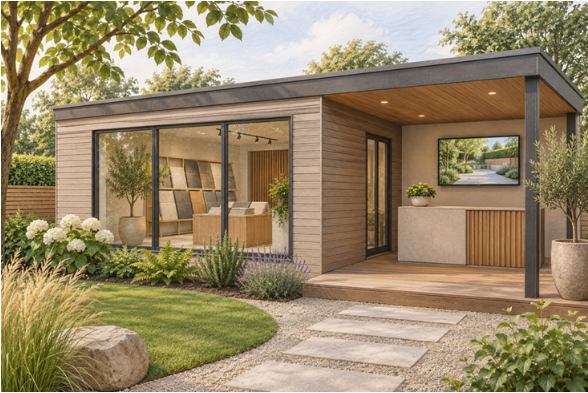
A home business can outgrow the dining table long before it needs a shop. Samples start living in the hallway, customer appointments interrupt family routines and every meeting begins with a hurried tidy. A small garden showroom offers another way to work: somewhere you can leave a display ready and welcome a customer without rearranging the house.
The room doesn’t have to feel like a miniature retail store. A few well-chosen displays, a comfortable comparison table and a clear arrival route can make a modest building useful. These small garden showroom design ideas concentrate on helping customers make decisions, while keeping the space manageable for the person running it.
Plan around the customer’s questions
Start with what people usually ask during an appointment. A furniture customer may want to feel a finish or understand the size of a piece. Someone choosing fabric needs to compare colours and textures. A garden design client might be trying to picture how materials sit together outdoors.
Give those questions a place in the room. If customers keep spreading samples on their knees, a proper table will help more than another display shelf. If they struggle to imagine the finished result, a small portfolio of completed work may be more useful than another row of loose materials.
Write down the stages of an ordinary appointment, including how it ends. Leave somewhere to record the choices and explain the next step. You want the customer to leave understanding what has been discussed, rather than remembering an attractive room but feeling unsure about the decision.
Make the exterior part of the welcome
The showroom starts at the garden gate. Customers should know which route to follow and where they are expected to wait. Keep the approach separate from private family space where practical, and check the permissions or restrictions relevant to the business use before investing in permanent alterations.
The building itself benefits from a restrained palette. When considering composite cladding, NeoTimber gives you a collection to explore against the rest of the garden. Compare samples beside existing brickwork, doors and paving. The wall finish will be seen in that setting every day, not on its own against a white background.
Ask how the full wall assembly will be constructed, including the corners and other finishing details. Have the underlying building condition and moisture management assessed appropriately. A new exterior should be the finishing stage of a sound building, rather than an attempt to disguise a problem underneath.
Show enough to explain the choice
Small showrooms can become crowded because every product feels too important to leave out. Unfortunately, a customer faced with many near-identical options may find it harder to understand what matters. Give the main choices some room and keep the wider range available in organised storage.
Group displays by the decisions people need to make. A customer comparing finishes should be able to see them beside a relevant product. Someone thinking about an outdoor colour scheme may benefit from seeing a few materials together. The arrangement should support the conversation rather than simply fill the shelves evenly.
Leave a little space between displays. It makes individual pieces easier to examine and gives you flexibility when the collection changes. A display that can be updated comfortably is more likely to stay relevant than one requiring a complete room rearrangement whenever a new sample arrives.
Set up a useful comparison table
A table earns its space when it gives both people somewhere to work. Check that you can place samples side by side, make notes and sit comfortably without blocking the route through the room. A narrow decorative console may look good yet leave too little usable depth.
If colour matters, consider how the surface and lighting affect what customers see. A neutral backdrop can make comparison easier. Explain that materials may appear different in their eventual setting, and encourage customers to assess suitable samples there before committing.
Keep the things you repeatedly reach for close by. A tape measure, pencil or product sheet shouldn’t require a trip back to the house. Give bags and coats another place so they don’t occupy the very surface intended for the consultation.
Give a display screen a specific job
Some products need context that won’t fit inside a small showroom. A screen can show a room before and after a project, present different layouts or explain a process that customers find difficult to visualise. Choose content around that need, rather than filling the room with a promotional loop.
Teksmart offers digital signage options to review where a dedicated display suits the business. Check the intended location, viewing distance and current product specifications before choosing hardware. Think about who will keep the content up to date, too. Outdated service information creates a problem that a better screen cannot fix.
Use photographs you have the right to show. Keep private customer details off public-facing displays, and make it easy to pause the screen when a conversation needs everyone’s attention. The technology should help explain the products without becoming another task competing for the owner’s time.
Leave room for the work behind the display
Packaging, spare samples and orders waiting for collection all need somewhere to go. Without a plan, they end up behind chairs or beneath the consultation table. That makes the room feel smaller and can force you to tidy hurriedly before every appointment.
Separate display storage from operational storage. Use closed cupboards for mixed supplies and give frequently used sample collections an easy-to-follow arrangement. Labels should help another person find an item, not only make sense to the owner who put it away.
Keep some spare capacity. A cabinet filled completely on the first day has nowhere for the next delivery. Review old samples periodically and remove information that no longer reflects the products you supply. A showroom feels considered when the collection is current, even if the total number of items is modest.
About NeoTimber
NeoTimber’s outdoor ranges include cladding, decking and fencing, with resources such as samples and installation guides available through its website. For a garden showroom project, its cladding collection provides a starting point for comparing the building’s visible finish with the materials around it.
Use that information alongside a discussion about the complete installation. The showroom exterior needs to suit the building and the maintenance you can provide, as well as the look of the business. Samples can then become part of a more informed conversation about colour, proportions and finishing details before the final order is placed.
Try the room before filling the last corner
Run a practice appointment with someone unfamiliar with the space. Ask them to follow the arrival instructions and compare a few options as a customer would. Notice where they hesitate, where they put their bag and which display makes the choice clearer.
Let those observations guide the last purchases. You may need better labels, a more useful chair or simply less clutter on the table. A small garden showroom works well when the customer can understand the products and the owner can prepare the room without losing half a morning. That practical ease is what makes the space worth having.Read more at https://decoratoradvice.ca/.